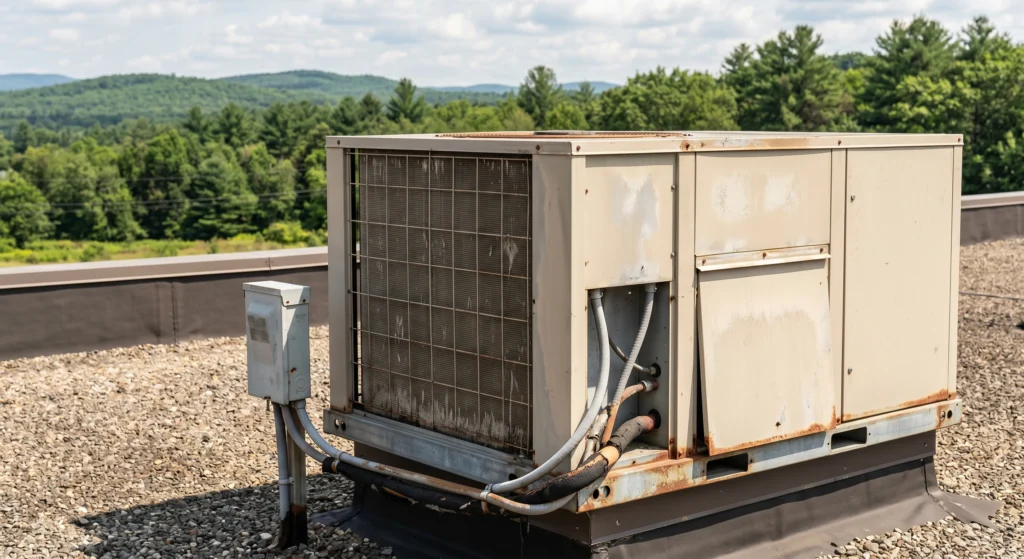
In a perfect world, commercial HVAC equipment would be replaced before it fails during a cold snap, heat wave, or busy operating week. In the real world, facility managers and business owners are often trying to balance repair costs, budgets, building occupant comfort, and timing.
The goal isn’t necessarily to replace equipment the moment it hits age twelve; it’s to know when an aging system needs a plan before a July heatwave or a January cold snap forces your hand.
As we head into the high-demand summer months in Laconia, Manchester, and beyond, here are six signs that your system is moving from reliable asset to financial liability.
1. Repair Calls are Becoming a Pattern
One repair doesn’t mean a system is dead. But if your team is seeing the same Rooftop Unit (RTU) on the service log every quarter, or if the cost of a single repair is approaching 50% of the unit’s value, you aren’t fixing the system anymore—you’re subsidizing its failure.
2. Comfort Complaints are Increasing
If Zone A is a sauna while Zone B is a refrigerator, the equipment may no longer be keeping up with the building’s load. Sometimes the issue is airflow or controls; other times, it’s a compressor or coil that can no longer perform under New Hampshire’s summer humidity. Persistent complaints usually lead to tenant churn or lost employee productivity.
3. Energy Costs and Total Cost of Ownership
Aging equipment uses more energy to deliver less comfort. In New Hampshire, where utility rates remain a significant overhead expense, a 15-year-old unit is often 20–30% less efficient than a modern system. Rather than looking at just the cost of a new unit, it is helpful to look at the Total Cost of Ownership. Between lower monthly kWh usage and the elimination of emergency service calls, a planned replacement often pays for itself faster than most owners realize.
4. The 2026 Refrigerant Transition
As of January 1, 2026, the industry has fully transitioned away from R-410A in new equipment. If your current system relies on older refrigerants, the cost to “charge” a leaking system has skyrocketed due to dwindling supply. Investing in a new A2L-compliant system now protects you from the refrigerant squeeze and ensures parts will be available for the next two decades.
5. The Equipment is Affecting Operations
In professional environments like banks, retail centers, or corporate offices, the cost of an aging HVAC system isn’t always a total breakdown. It’s the friction it creates in daily operations. This shows up as:
- Management Distraction: Your team is spending time managing hot/cold tickets and scheduling emergency service instead of focusing on the business.
- Tenant Friction: In a competitive New Hampshire leasing market, consistent comfort is a baseline expectation. Frequent adjustments, fixes or loud, struggling units can lead to tenant dissatisfaction and influence their decision to renew.
- Unpredictable Budgeting: When a system is unreliable, you lose the ability to forecast your expenses. You are essentially waiting for the equipment to dictate your capital spend, rather than choosing when to invest on your own terms.
6. You Value Predictability
The most successful facility managers don’t wait for equipment to dictate their schedule; they stay in the driver’s seat. Even if your systems are performing well today, there is a distinct competitive advantage to having a Multi-Year Asset Roadmap. By shifting from reactive repairs to strategic planning, you can:
- Master Your Capital Budget: Align equipment upgrades with your fiscal cycles so there are no unplanned hits to your bottom line.
- Dictate the Timing: Schedule replacements during the Spring and Fall shoulder seasons when building occupant impact is lowest and lead times are shortest.
- Protect Your Investment: A well-documented lifecycle plan ensures your mechanical systems remain a high-performing asset. Instead of letting aging equipment devalue your building, you are proactively maintaining its health and protecting your long-term equity.
Quick Reference: Replace vs Repair (2026 Standards)
| Indicator | Repair Likely | Replace Likely |
| System Age | Under 12 Years | 15+ Years |
| Refrigerant Type | Modern A2Ls | Outdated R-22 or R-410A |
| Repair Cost | Under 20% of new unit cost | Over 50% of new unit cost |
| Efficiency | Meets current standards | High kWh waste / No VFDs |
| Operational Impact | Minor/Maintenance related | Occupant complaints/ Downtime risk |
| Budgeting | Predictable maintenance | Unplanned emergency spikes |
At Wicked Cool Mechanical, we help New Hampshire facilities managers and business owners move from emergency mode to informed mode. We provide the technical data and HVAC Due Diligence you need to make smart decisions around budget, timing, and building performance.
Don’t let a summer breakdown dictate your budget. Contact Wicked Cool Mechanical for a System Assessment Today